


Ghosts Under The Low Ceiling, Dead Dads Club Tear Through Camden Assembly
The Camden Assembly – 19th May 2026
IMAGES / WORDS ALAN BRYCE
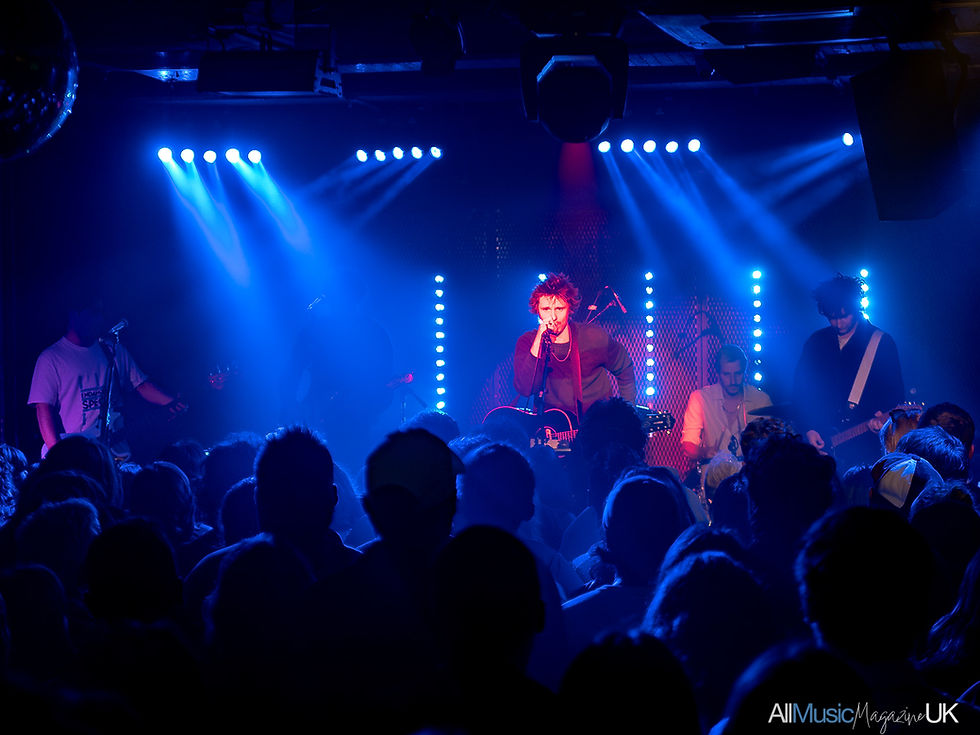
There are nights when Camden Assembly feels like a museum piece - all history, all ghosts of better bands sweating through the same low ceiling. And then there are nights like 19 May, when the place feels violently alive again, packed far beyond comfort, every inch of that roughly 400-capacity space pushed to its limits, the crowd a strange, beautiful collision of types who would normally avoid eye contact in daylight.
I was in early, already wedged into a knot of bodies that didn’t look like they belonged to the same story. Old Palma Violets diehards in battered leather, younger kids discovering Jesson for the first time, industry hangers-on pretending they weren’t watching too closely, and a handful of curious wanderers who’d just followed the noise upstairs and got trapped in it. The room buzzed before a note had been played, not polite anticipation, but that specific Camden tension where people are ready to be convinced or to completely switch off.
Touch Cookie walked into that atmosphere and did the smart thing: they didn’t ask permission.
They came on jagged, immediate — guitars crackling like faulty wiring, rhythm section snapping forward with the kind of restless pulse that refuses to sit still long enough to be categorised. You could hear the lineage in there — scrappy alternative instincts, a bit of art-school ambition — the kind of London band that’s still shaping itself gig by gig.
Their frontperson jittered between confrontation and charm, eyes darting, body never quite settled. They played like a group that knew this wasn’t their crowd but also knew that didn’t matter if they made enough noise to disrupt it. And they did. Gradually, people turned. Heads came up from drinks. Conversations stalled mid-sentence.
By the time they finished, they’d shifted the room just enough - stripped away the indifference, left behind a nervous energy hanging in the air. They didn’t overstay, didn’t self-indulge. They set the fuse and stepped back. Perfect.
Then the lights dropped again, darker this time, heavier, and Dead Dads Club appeared not like a band entering a stage, but like something already halfway through an internal collapse.
Chilli Jesson was at the centre of it — and it’s impossible to watch him without carrying his past with you. Because this is a man who once burst out of South London with Palma Violets, that chaotic, generation-defining indie flashpoint where everything was irony, sweat, and momentum. And then came the unravelling, the split, the recalibration, Crewel Intentions, the quieter solo work, the years of trying to figure out what was left once the noise died down.
All of that hangs on him now — but here’s the thing: he’s not trying to resolve it.
He’s using it.
Dead Dads Club doesn’t feel like a continuation. It feels like a reaction. The old swagger is still there in flashes — you see it in the way he locks onto the crowd, in the instinctive control he has over a room — but it’s been cracked open. There’s something more exposed now, less interested in performance as spectacle and more in performance as… confession, maybe. Or confrontation. Or just survival.
The opening track came in sideways — not a bang, but a tear. The band slid into place like they were already mid-song, mid-thought, mid-argument. The sound was loose but deliberate — basslines prowling rather than grounding, drums clipped and tense, guitars pushing from skeletal minimalism into full distortion at a moment’s notice.
Jesson moved constantly. Not strutting — pacing. Circling the mic, stepping back, leaning in like he didn’t fully trust what was about to come out of his mouth. When he sang, it wasn’t always about melody — it was about urgency. Lines came out jagged, sometimes stretched, sometimes almost spoken, like he was deciding in real time whether they deserved to exist.
And the crowd, that crowd, shifted.
It’s always the same moment, and you can feel it physically. That instant when a packed room full of people who came for different reasons suddenly realises, they’re all in the same place for the same thing. Conversations drop off. Movement slows. The air tightens.
By the middle of the set, it had happened.
Dead Dads Club don’t give you easy peaks. They don’t do the tidy arc. Instead, the set felt like it was constantly folding in on itself, stretching out, collapsing, rebuilding. One track sagged into a near ballad — fragile, almost tender — before being split open by a vicious guitar figure that cut through the room like broken glass. Another locked into a repetitive, grinding groove that Jesson circled obsessively, repeating fragments of lyrics until meaning dissolved and all that was left was rhythm and tension.
It wasn’t always comfortable. It wasn’t supposed to be.
And through it all, there were these flickers of his past selves — echoes of the Palma Violets chaos, the more theatrical leanings of later projects — but here they felt like ghosts rather than anchors. He wasn’t recreating anything. He was letting it leak through and then destabilising it.
Quickly — the lighting. It was savage. Too low, too contrast-heavy, the band slipping in and out of shadow, backlit into oblivion one minute and barely visible the next. Atmospherically, it worked. Practically — for anyone trying to shoot the thing — it was a war zone. But maybe that’s the point. This wasn’t a gig designed to be captured cleanly.
The final stretch of the set felt like the band pushing against their own boundaries — tempos nudging forward, songs bleeding into each other, structures loosening further. There was a sense they might overshoot, lose control completely.
They didn’t.
They just stopped.
No encore bait. No grand statement. Jesson muttered something that might’ve been a thank you, already half-turned, and they walked off like the evening had reached its natural breaking point.
And suddenly you’re back in Camden. Packed pavement, neon, traffic, people already onto the next thing.
But it sticks with you.
Touch Cookie started the night by jolting the room awake. Dead Dads Club took that energy and twisted it into something far less stable, far more human. And Jesson — carrying the weight of Palma Violets’ past, the reinventions that followed, and the grief that seems to power this project at its core — turned it all into something that refused to behave like a normal gig.
It wasn’t polished. It wasn’t perfect.
It was better than that — it was alive, unpredictable, occasionally uncomfortable, and for a moment, in a packed, sweating room full of strangers, it felt like everyone was tuned into the same fragile, flickering signal.
That’s not something you get often.
And it’s the only reason nights like this matter.
Set list unavailable
FOLLOW DEAD DADS CLUB
Comments